
In Lahore, a Mob Tries Samuel Arif for Blasphemy Before Any Court Gets the Chance
Samuel Arif, a 26-year-old Christian, is on judicial remand in Lahore on blasphemy charges after residents beat him and police took him into custody. His family says a personal feud, not any insult to religion, lies behind the accusation.
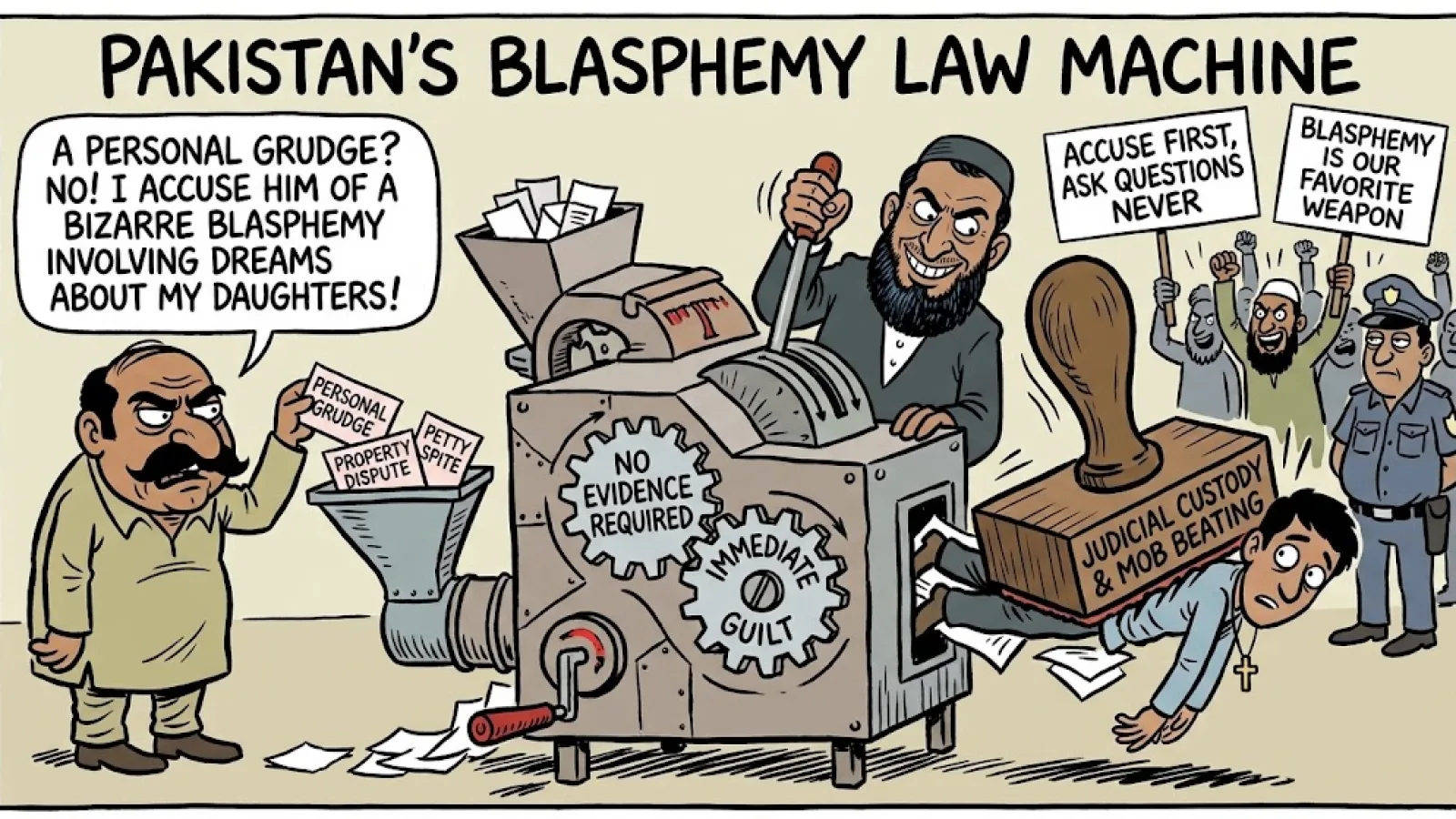
Pakistan's Penal Code contains two sections that, used together, can turn a neighborhood complaint into a capital case. Samuel Arif, a 26-year-old Christian from Lahore, has now met both of them. He is being held on judicial remand on blasphemy charges, a category of offense in which, by long local custom, the punishment tends to arrive well before any proof.
Two sections, one FIR
The case is recorded as First Information Report (FIR) No. 806/26. It rests on:
- Section 295-C of the Pakistan Penal Code, which imposes a mandatory death sentence for derogatory remarks against the Prophet Muhammad;
- Section 298-A, which covers remarks against holy personages and companions.
The complainant is Muhammad Umair Alam Khan, who lives in the colony. His account runs as follows. Arif stopped Khan's two minor daughters inside the colony and used derogatory religious language toward them. He told them the prophet had visited him in a dream and instructed him to marry the girls. He then tried to smear an unidentified substance on their faces.
Justice, express delivery
The neighborhood's version of due process moved faster than any court could. Once the accusation got around, residents cornered Arif at a gym on the colony grounds and beat him severely. The police let the crowd conduct the preliminary hearing and then took the suspect into custody.
Old streets, old friends
The setting was familiar ground for Arif. He had spent more than ten years of his life in Block A of the Punjab University Staff Colony. His family had a home there through his late father, Arif Masih, a sanitary worker employed by the university. After Masih died, the family moved to Saint Mary's Colony in Gulberg. Arif kept coming back to his old neighborhood to see friends.
The feud defense
Arif's family rejects every allegation. He is innocent, they say, and the complaint grew out of personal enmity. That explanation will surprise no one who follows these cases. Rights advocates have long observed that in Pakistan, a blasphemy allegation is an exceptionally effective way to win a private quarrel, because it puts the accused and his relatives in immediate physical danger.
Arif does at least have lawyers. HARDS Pakistan (Human Assistance & Development Services), a non-governmental organization, is providing legal support to the family. Attorneys Kashif Alexander Rajput and Nadia Hameed have been appointed to argue his defense in court.
Human Rights Focus Pakistan (HRFP) and other advocacy groups have asked provincial authorities for something that ought to be routine: a fair, transparent and impartial investigation. Their list of demands reads like the first chapter of a law textbook:
- due process;
- legal protection for the accused, for witnesses and for family members;
- accountability for anyone who takes the law into their own hands.
Local rights activists and the Christian community say they are alarmed once more. They see the case as fresh proof that blasphemy legislation keeps doubling as a tool for settling private scores. Arif remains in judicial custody. His fellow Christians are praying for his family and for justice. They are also waiting for a thorough, unbiased investigation that establishes the truth, an ending that remains something of a collector's item in cases of this kind.
Sources
Countries
Read also

Death Row on Shuffle: Nigeria's Top Court Keeps Skipping a Musician's Appeal
Yahaya Sharif-Aminu was sentenced to hang over a song he shared on WhatsApp. Six and a half years on, Nigeria's Supreme Court still has not managed to fit his appeal into its schedule.
Death row first, evidence check later: Lahore judges query Facebook proof against Junaid Hafeez
Prosecutors in Pakistan have been told to show that the digital evidence used to convict Junaid Hafeez is both admissible and authentic. The former lecturer has been on death row for blasphemy since 2019, and his appeal has been waiting since 2020.
Saudi appeals court sentences Sri Lankan Tamil worker to death over Facebook comment
Sivarasa Anojan, a Tamil migrant worker from Sri Lanka, now faces the death penalty after a Saudi appeals court replaced his five-year prison term for blasphemy tied to a Facebook comment. A Sri Lankan MP is challenging the government's handling of the appeal.